A Variation on Bertrands Paradox
Foreword
Exercise 4 of Georgii’s second chapter deals with a variation of a famous paradox of probabiliy theory, namely Bertrand’s Paradox. The latter is an example of stochastic geometry and asks about the probability that a random chord drawn inside a circle is longer than the side of the triangle that is inscribed in the circle. There are different ways to choose a chord randomly, resulting in different probabilities and hence the seeming paradox.
Problem
Georgii (2014, Chapter 2, Ex. 4) requires to derive an explicit expression for the probability density of the distance of the chord to the circle center if (i). the chord center is uniformly distributed across the circle and (ii.) if the angle between the circle center and both chord endpoints is uniformly distributed.
Solution
The solutions to both are a worthwhile exercise in basic geometry. For the solution to (i), consider the following image I created in Tikz which shows the circle $Z$ and some (uniformly drawn) random point within the circle.
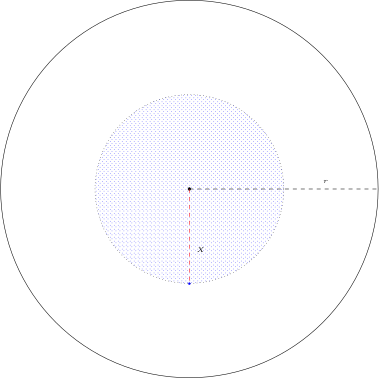
The distance of the circle center to that point is $x$. The set of points $A$ that have a distance $\leq x$ from the circle center is $A := {y \in Z: \Vert y \Vert \leq x}$. In other words, they lie in a circle around the circle center with radius $x$. Since $\vert A \vert = \pi x^2$ and $\vert Z\vert = \pi r^2$, we have that
\begin{equation} F_X(x) = P(X \leq x) = \frac{\vert A \vert}{\vert Z\vert} = \frac{\pi x^2}{\pi r^2} = \Big(\frac{x}{r}\Big)^2 \end{equation}
But then
\begin{equation} \boxed{f_X(x) = \frac{\text{d}}{\text{d}x} F_X = \frac{2x}{r^2}} \end{equation}
For (ii), consider the following image, also created in Tikz.
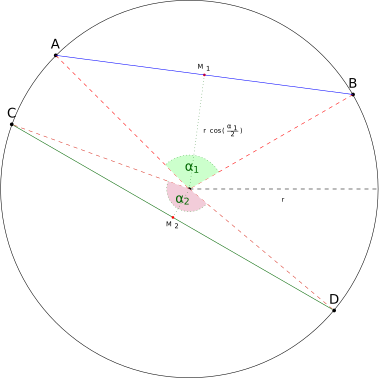
Let $r$ be the radius and $X$ the distance of the circle center to the midpoint of the chord. Based on the image it is clear that $\frac{\alpha_1}{2} = \arccos(\frac{X}{r})$. Conversely, it is $X = \cos\Big(\frac{\alpha_1}{2}\Big)r$.
The probability for a distance $X \leq x$ with $x \in [0, r]$ is hence \begin{equation} F_X(x) = P(X \leq x) = P(\cos\Big(\frac{\alpha_1}{2}\Big)r \leq x) = P(\alpha_1 \geq 2\arccos(\frac{x}{r})) = 1 - P(\alpha_1 < 2\arccos(\frac{x}{r})) = 1 - \frac{2}{\pi}\arccos\Big(\frac{x}{r}\Big) \end{equation}
and the probability density therefore
\begin{equation} \boxed{f_X(x) = \frac{\text{d}}{\text{d}x} F_X(x) = \frac{2}{\pi}\frac{1}{\sqrt{1 - \Big(\frac{x}{r}\Big)^2}}\frac{1}{r} = \frac{2}{\pi}\frac{1}{\sqrt{r^2 - x^2}}} \end{equation}
since $r > 0$.